🚨 MARCH 2026 UPDATE: On March 2, 2026, the UK Government officially launched a 3-month national consultation titled “Growing Up in the Online World.” This landmark move specifically asks for public and industry evidence on mandatory age-verification for VPN services.
The consultation closes on May 26, 2026. This article has been updated to reflect the new GRC compliance risks associated with these fast-tracked legislative powers.
UK Banning VPNs: The 2026 “Amendment 92” Guide
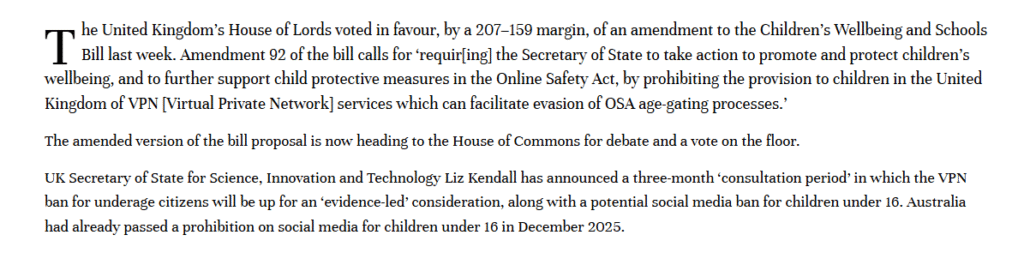
The “cat and mouse” game between the UK government and privacy tools has reached a breaking point. Following the full rollout of the Online Safety Act (OSA), the House of Lords has recently pushed Amendment 92 to the Children’s Wellbeing and Schools Bill. Many experts are now asking: is the UK banning VPNs by stealth?
This isn’t just another tech update—it is a fundamental shift in how the internet works in the UK.
The 2026 Reality: What is the UK Banning VPNs Proposal?
Passed in the House of Lords and currently under heavy consultation as of March 2026, this amendment seeks to close the “VPN Loophole.” While the government stops short of an outright nationwide UK banning VPNs order for adults, the 2026 proposal aims to:
- Mandate “Highly Effective” Age Assurance: Force providers to verify that any user is over 18, effectively ending anonymous access.
- Target “Relevant VPN Services”: Specifically those marketed to UK consumers.
- Empower Ofcom: To monitor and penalize providers who allow unverified “Child VPN” access, fueling fears of a wider UK banning VPNs landscape.
Community Perspective: The Practicality Crisis
While the legislative debate continues in the House of Lords, the technical community has raised significant alarms regarding the feasibility of a UK banning VPNs mandate. Security professionals point out that VPNs are not merely “privacy tools” but are foundational infrastructure for modern global business.
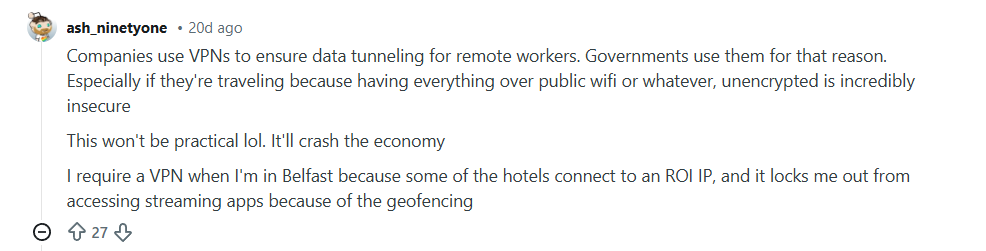
As noted in the community discussion above, many users rely on VPNs to secure remote work data and bypass “accidental” geofencing in regions like Belfast. From a GRC perspective, any regulation that treats VPNs as “illicit tools” ignores the fact that they are a mechanical necessity for data tunneling and protecting employees on public Wi-Fi.
The “Normalization” Trap: Why Complacency is a Risk
A secondary concern shared by the more tech-literate segments of the UK public is the “slow-creep” of digital restrictions. The argument is that the government does not need a 100% effective ban to achieve its goals; they only need to impact the non-tech-literate majority to shift the social norm.
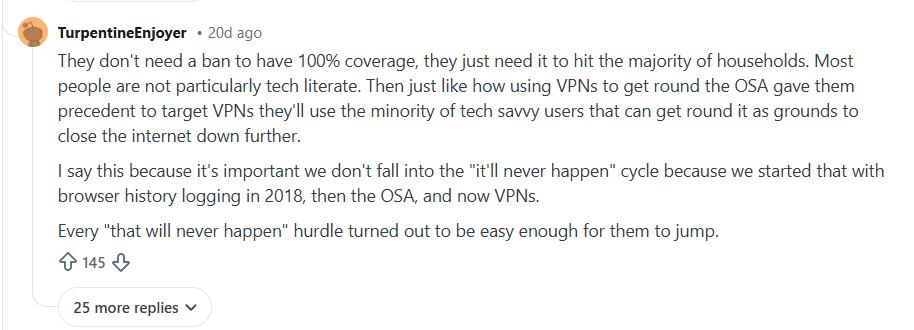
This perspective highlights a historical pattern: from browser history logging in 2018 to the Online Safety Act, each “unthinkable” regulatory hurdle has eventually been cleared. For those monitoring the UK banning VPNs landscape, the risk is that these “minority” tech-savvy workarounds will eventually be used as a pretext to close down internet freedoms even further.
The GRC Nightmare: Why This Matters for Professionals
For those focused on Governance, Risk, and Compliance (GRC), the talk of the UK banning VPNs creates a massive “Compliance Collision.” If you are a security lead, you are now facing a dual-threat:
- The Identity Liability: If a provider is forced to collect government IDs to prevent a UK banning VPNs penalty, they are creating a centralized database of high-value targets.
- The Zero Trust Conflict: Modern security relies on Zero Trust. By forcing an age-checker into the mix, the “privacy tunnel” is broken before you even log in to your company network.
Expert Insight: Any move toward the UK banning VPNs for certain age groups is a GRC red flag. In 2026, the industry is moving toward Self-Sovereign Identity (SSI)—proving you are “Over 18” without revealing your name.
Best “Safe Haven” VPNs for 2026
If you are an adult that is worried about the UK banning VPNs or looking to maintain your legal right to privacy without handing over biometric data to every app, these three providers remain the gold standard in the current regulatory climate:
| VPN Provider | 2026 Privacy Status | Why it Wins |
| Proton VPN | Swiss Protection | Switzerland does not recognize UK age-mandates; their “Stealth” protocol is built for this. |
| Surfshark | Identity Shield | Alternative ID (included) lets you generate a proxy name and email to satisfy age-checks without revealing your real ID. |
| NordVPN | Quantum-Ready | Their 2026 infrastructure includes “Obfuscated Servers” that hide the fact you are even using a VPN from your ISP. |
The Top 2026 Privacy Contenders: A Closer Look
1. Proton VPN: The Swiss Jurisdictional Fortress
As the UK government increases pressure on domestic ISPs, Proton VPN remains the premier choice for high-stakes privacy. Operating out of Switzerland, they are not subject to UK or EU data retention mandates. In 2026, their Stealth Protocol is specifically engineered to bypass deep-packet inspection (DPI), ensuring that your VPN usage remains invisible to the automated age-verification filters currently being tested by UK network providers.
2. Surfshark: The Identity Shield & Alternative ID
While most providers focus solely on the “tunnel,” Surfshark has pivoted to address the 2026 “Identity Crisis.” Their Alternative ID tool is a mechanical necessity for modern “Financial Hygiene.” It allows you to generate a valid-proxy persona to satisfy mandatory site registrations without linking your real name, address, or biometric data to a centralized database—keeping your primary identity siloed and safe from the surge in UK database leaks.
3. NordVPN: Post-Quantum Resilience
With the 2026 rise of AI-driven decryption, NordVPN has stayed ahead of the curve by implementing Post-Quantum Cryptography across its core server network. This ensures that any data intercepted today cannot be decrypted by quantum computers in the future. For banking and sensitive business communications, NordVPN’s Obfuscated Servers are essential for maintaining a stable connection in regions where “VPN-detection” AI is becoming the new standard.
The “Albania Strategy” & Router-Level Privacy
Since the talk of the UK banning VPNs began, many users have shifted to Router-Level VPNs. By installing a VPN on your router using WireGuard or OpenWrt, you protect every device in your home—including smart TVs and IoT devices—without having to verify your age on every single app.
Conclusion: The Future of UK Privacy
The UK government’s 3-month consultation ends in May 2026. Until then, the use of a high-quality, out-of-jurisdiction VPN remains the most effective way to ensure your banking, browsing, and business data stays private.
In the world of GRC, Resilience is the goal. Don’t wait for the “VPN Ban” to take full effect; audit your privacy tools today.
Disclaimer: This article is for informational purposes only and does not constitute legal or professional GRC advice. Regulations regarding the Online Safety Act and VPN usage in the UK are subject to change following the May 2026 consultation period. Always ensure your digital activities comply with local laws.
Leave a Reply