Thinking it is convenient to use free public WiFi just to think that you don’t have to spend a single penny, discover more about the risks that you might face if your luck is not good enough.
1. Introduction: The Fear is Real
Free public WiFi is one of life’s great conveniences, but it comes with a high-stakes hidden cost: your privacy. Most people never think twice about the security of their data until they dive into a “rabbit hole” of network security risks. The fear you feel when logging in at a café is completely justified.
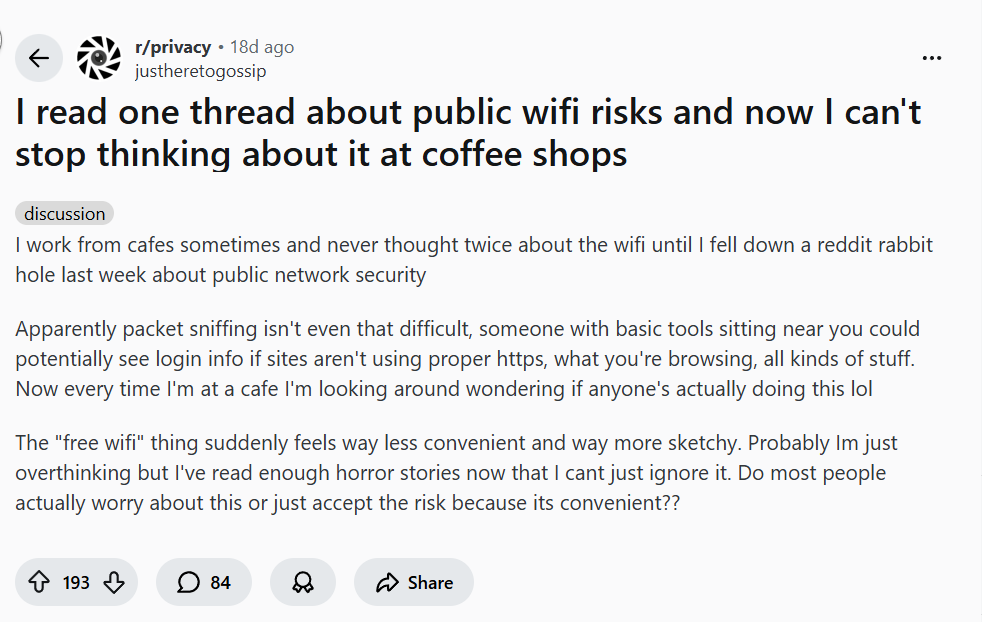
The threat isn’t a complex, government-level attack. Using the free public WiFi, it’s simple: someone with “basic tools sitting near you” can potentially see your login info, what you’re browsing, and more if a site isn’t using proper security. This is called packet sniffing.
In an environment where you are often told to “never trust anything unless you own it”, the fundamental solution is to treat every public WiFi network as compromised and add an airtight layer of personal encryption: a Virtual Private Network (VPN).
2. The Threat on the Network: Why HTTPS Isn’t Enough
The primary risk on public Wi-Fi is that it is often unencrypted or weakly secured. This makes it an easy target for attackers looking to monitor data traffic.
A. The Packet Sniffing Problem
Packet sniffing involves a hacker capturing and viewing data packets traveling through the network. If your data isn’t properly encrypted, they can extract sensitive information like usernames, passwords, and session tokens. While many sites now use HTTPS (Hypertext Transfer Protocol Secure) to encrypt the connection between your browser and the website, this doesn’t protect against all threats:
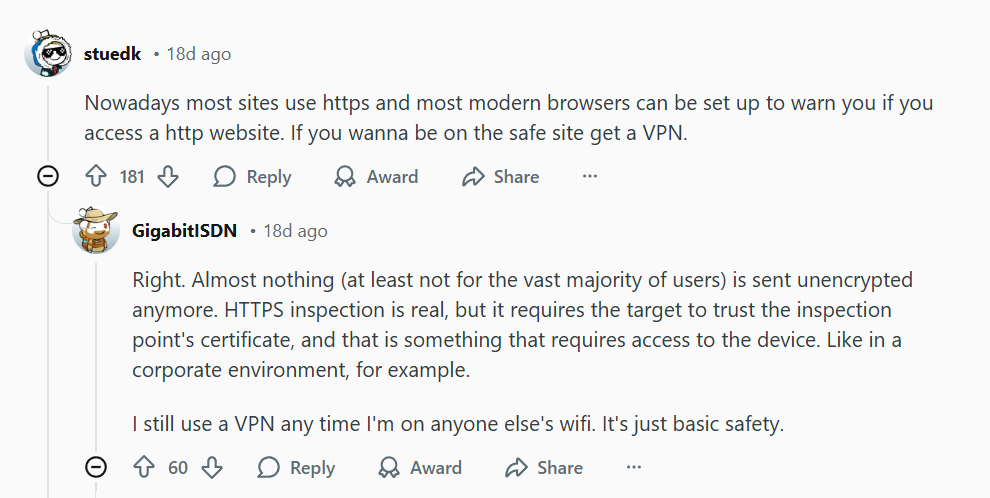
One expert notes that while HTTPS is common, it requires the user to trust the inspection point’s certificate, which can be an issue in non-private environments.
B. The Consensus: Basic Safety Requires a VPN
The overwhelming consensus from cybersecurity professionals is clear: A VPN is basic safety when connecting to any third-party network.
” The same user above also stated they “still use a VPN any time I’m on anyone else’s wifi. It’s just basic safety”.
VPNs encrypt your traffic, protecting you from eavesdropping and man-in-the-middle attacks on public networks.
3. The VPN Solution: Your Private Tunnel
A VPN creates a secure, encrypted tunnel between your device and a server, making your data unreadable to anyone else on the local public WiFi network. It’s the most secure option for digital privacy on public WiFi.
A. NordVPN: The Best Overall Security and Speed
B. Surfshark: Best for Budget and Unlimited Devices
C. Proton VPN: The Privacy Expert’s Choice
4. Essential Security Habits (Beyond the VPN)
While a VPN is mandatory, you should also adopt these habits when using public Wi-Fi:
- Disable Auto-Connect: Turn off your device’s setting to automatically connect to available public WiFi networks.
- Turn Off File Sharing: Ensure file and printer sharing is disabled to prevent others on the network from accessing your folders.
- Avoid Sensitive Logins: Never log into banking or other highly sensitive accounts over public WiFi, even with a VPN, for maximum caution.
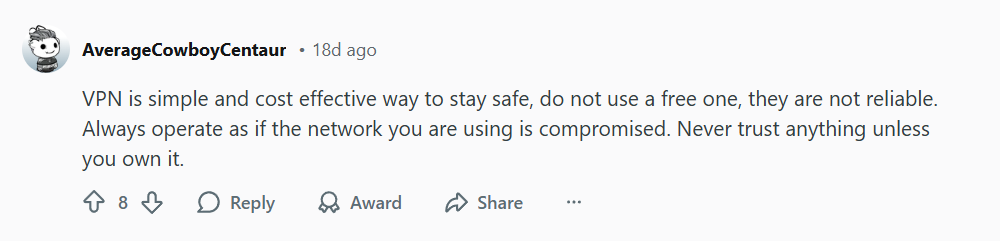
- Never Trust: Always operate “as if the network you are using is compromised.”
- If possible, allocate some of your budget to purchase a premium VPN instead of the free one. A free VPN has many risks, like data leaks, unstable connections, etc. I mean, they need to make money somehow even if you don’t pay them.
5. Conclusion
The convenience of free public WiFi simply isn’t worth the risk of exposing your passwords, banking details, and private information to lurking attackers. While modern browsers offer some protection, a VPN is the single, cost-effective, and simplest way to stay safe.
Leave a Reply to Social Engineering 2025: Why Your Best Defense Online Isn't Just Technical – VPN Guide Pro Cancel reply